What is Water Color Painting?
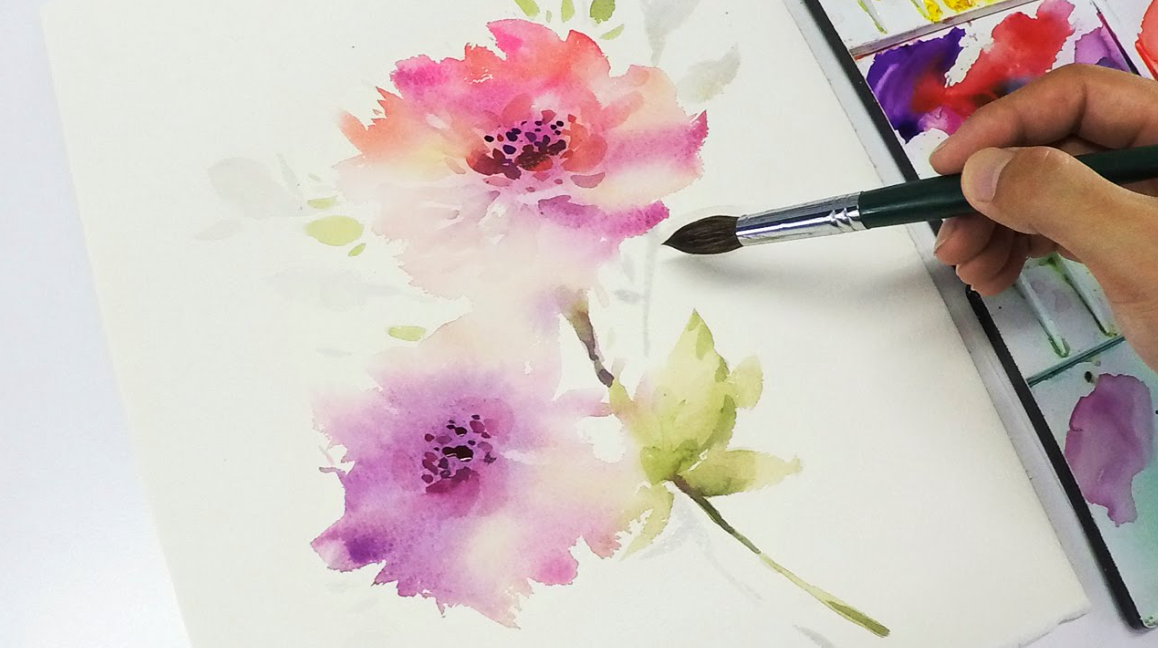
Watercolor, or water painting, is an old painting technique. It dates back to prehistoric times but was recognized during the Renaissance and has been modernized over time. The watercolor technique involves mixing colored pigments and water. The more water, the lighter the color. Conversely, the less water, the more intense the color. Watercolor paintings are often used for landscape, marine, or urban paintings… accuracy, and detail are key elements of this technique. Art spur brings you 10 watercolors you need to know. From water media paintings by famous artists and beloved teachers to works by artists who were at the height of their careers at the time of publication,
Definition
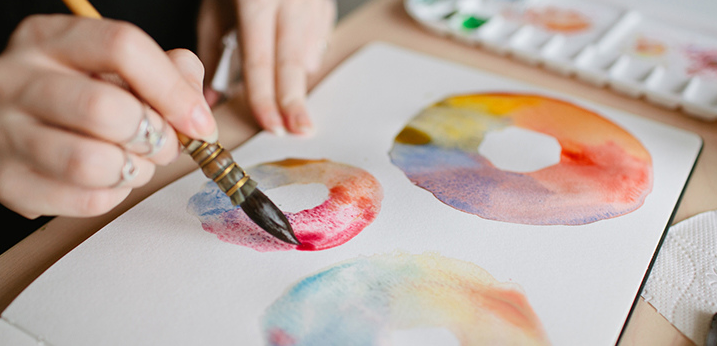
Watercolor is named for its primary ingredient. It consists of a pigment dissolved in water and bound by a colloidal agent (usually a gum, such as gum arabic); It is applied with a brush to a supporting surface such as vellum, fabric, or more commonly wet paper. The resulting trace (after the water evaporates) is transparent, allowing light to reflect off the support surface to a glossy effect. Watercolor is often mixed with gouache (or “body color”), an opaque water-based paint containing a white element derived from chalk, lead, or zinc oxide.
Content
The rise of watercolor painting as a serious artistic endeavor went hand in hand with the improvement of its materials and commercial development.
Paints
Initially, artists grounded their colors with natural pigments, or purchased paint in liquid form. However, in the last two decades of the eighteenth century, artists could purchase small, hard cakes of soluble water color (invented by William Reeves in 1780). To prepare the paint, an artist dipped the cake in water and rubbed it onto a suitable vessel, such as an oyster shell or porcelain. In the 1830s, artists could purchase wet watercolors in porcelain. An even bigger advance came in 1846, when Winsor and Newton introduced wet watercolors in metal tubes (following the example of tubed oil paint, first sold in 1841). Machine ground pigments produced by British manufacturers produced fine, uniform watercolors that set international standards.
In 1834, Winsor and Newton introduced their patented zinc oxide pigment “Chinese White”. This extremely fine—and therefore easily applied—permanent color greatly improved the quality of the corner. In the first half of the nineteenth century, J. M. W. Turner began the practice of using white gorse as a wash. In the second half of the nineteenth century, Pre-Raphaelite painters used white gouache as a ground on which to paint in precise, miniature-like styles.
Paint boxes
By the mid-eighteenth century, British artists regularly sketched outdoors. In watercolor, they found a medium that suited their needs, capable of capturing the transient effects of light and weather, and required easily portable materials. First, artists made their own carrying cases: a treatise on watercolor painting published in 1731 provides instructions for making a pocket-sized ivory case containing thirty-two colors, brushes, a portico crayon; (a drawing instrument consisting of thirty-two colored sections. Chalk), and a compass turned made something equally effective by sticking a watercolor cake in a leather carrying case (modified from its original use as an almanac cover). Later, artist dyers sold the finished boxes. The most luxurious—made of mahogany, and fitted with brass hardware and embossed leather lining—porcelain mixing pans, wash bowls, storage tins for chalk or charcoal, trays for brushes and port crayons, And scratchpads, ink blocks, and colors as less expensive alternatives met the demands of a growing number of amateur artists. A pocket-sized “shilling color box” in Japanese tin with compartments for color and mixing pans, as well as separate tin water pots that were hinged to the rim. Commercially available from the 1830s, it became a Victorian bestseller (over 11 million units sold from 1853 to 1870).
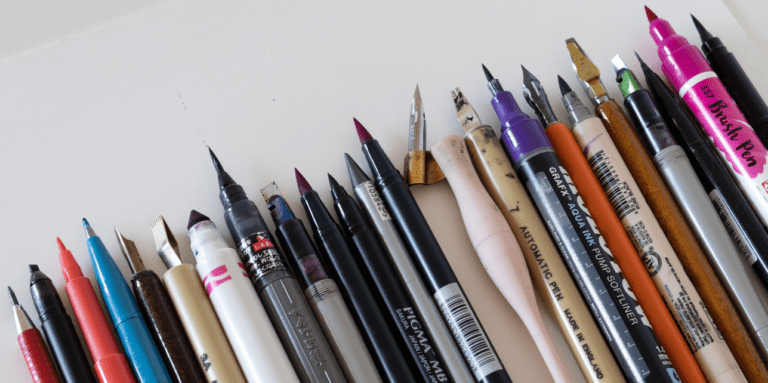
Brushes and Other Tools
The fine hair of the Asiatic marten (or Russian sable)—which comes easily to a point in the mouth, holds a large amount of color, and bends against the surface of the paper—gives watercolor painters a soft, firm texture. and supplied durable coloring materials. Such “sable” watercolor brush handles were first made from quills, and later, from metal-driven wooden shafts. Additional tools became common for watercolor painters during the nineteenth century, when “subtle” painting techniques developed: Scrapers, sandpaper, penknives, brush handles, or fingernails were used to remove the dry or wet paint from the surface of the paper to create highlights; Sponges, brushes, breadcrumbs or scraps of paper were used to stain watercolor washes and soften their intensity.
Paper
The development of woven paper in the late eighteenth century laid the foundation for future technological advances in watercolor painting. While earlier papers retained the parallel lines of their papermaking molds, which caused wet watercolor washes to pool, woven papers showed virtually no impression of their fine, wire-mesh molds. This allowed painters to apply smooth, precise washes of watercolor without interruption.
Vouveau paper appeared in a published book as early as 1767, and artists quickly sought it out. By the 1780s, James Whatman had developed a wove paper of ready size with gelatin for use with watercolors. (Sizing the sheet with animal glue, gum, or egg provides a protective coating that reduces damage from wetting, reworking, and reworking.) During the nineteenth century, various sizes, textures, And a bewildering array of watercolor papers. Surfaces emerged to accommodate the expanding techniques of the medium. By 1850, Leading manufacturer Whatman offered papers with three distinct levels, from least to most textured: “HP” (“hot pressed”), suitable for detailed articles; “No” (“not hot pressed”), suitable for less precise work; and “rough” (“cold pressed” or “unpressed”), suitable for sketchy effects. A fourth option, the “Griffin Antiquarian”, developed in conjunction with Winsor and Newton, offers a huge sheet of exceptional strength. The trend for extremely hard surfaces that could withstand large amounts of scrubbing, clawing, and scraping continued into the nineteenth century, culminating in J. Barcham Green & Son’s “O.W.” Paper, a gelatin-sized pure linen board produced by painter John William North in 1895, and certified by the Royal Watercolor Society.
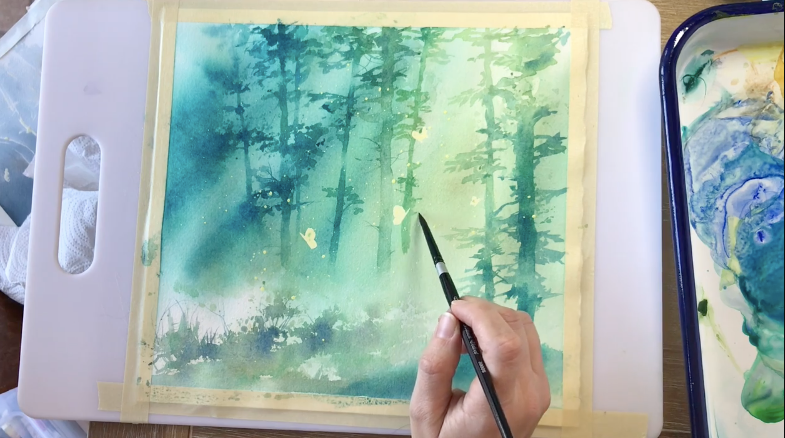
To prevent the thinner papers from caking when wet with watercolors, artists usually stretched them. Initially, they glued or pinned the edges of the wet sheet to an ordinary drawing board. Later (at the beginning of the nineteenth century), they tied it to a commercially produced stretching board. One type has a mahogany frame attached to the backboard. Its popularity is understandable: such stretching frames are a work-in-progress aspect of the image produced for exhibition.
History
The technique of water-based painting dates back to ancient times and is associated with the history of many cultures around the world. In the West, European artists used watercolor to decorate illuminated manuscripts and color maps in the Middle Ages and to paint miniature studies of nature and portraits during the Renaissance (50.69.2; 35.89.4). Took
Today, the medium is most commonly associated with Britain during the period spanning roughly the mid-eighteenth century to the mid-nineteenth century—known as the Golden Age of Watercolor. The tradition began with almost monochromatic examples: topographical drawings made in graphite or ink, and by William Taverner (1703–1772), Paul Sandby (baptized 1731–1809), Thomas Hearne (baptized 1731–1809). As artists were colored by a limited range of colored washes. 1744-1817), Michael “Angelo” Rooker (1746-1801), and Thomas Malton (1748-1804). A variant of monochromatic landscape drawing, in which a design drawn in deep ink is washed with a single color, was developed by the influential drawing master Alexander Cozens (1717–1786) and Joseph Wright. continued it, called the “Rite of Derby” (1734-1797).
While some artists, such as Thomas Rowlandson (1757–1827), continued to produce “tinted drawings” well into the nineteenth century, other artists began to challenge the convention of strong outlines and pale colors in favor of more painterly effects. , which was achieved using Fluency. Strong color wash. Some—such as Jonathan Skelton (active 1735–59), Francis Towne (1739–1816), William Parse (1742–1782), Thomas Jones (1742–1803), John “Warwick” Smith (1749–1831), and Most importantly, a period of study in Italy by John Robert Cozens (1752–1797) (67.68), son of Alexander Cozens mentioned above—led to this change. Others, such as JMW Turner (1775–1851) and Thomas Girton (1775–1802) (06.1051.1), drew inspiration from the works of other artists (notably, JR Cozens) and the example of oil paintings.
.
33 Watercolor Paintings You Need To Know
1. Cathedral of Llandaff, Paul Sandby
The father of watercolor is Paul Sandby, an English watercolor artist of the 18th century. He began by painting a series of castles and made a series of plates and caricatures which he published anonymously. In 1778, he painted Llandaff Cathedral in Wales. Measuring 129mm by 182mm, this watercolor is an excellent example of the painter’s style.
Paul Sandby, Llandaff Cathedral, 1778
2. Place de Diaghilev, Nadéra Benmansour
Straight from Oran, Nadra Benmansour moved to France in 1999 where she began painting watercolors. Exhibiting in several cities, she paints scenes from Algeria but also the city of Paris. In 2016, Nadra painted the Place de Diagelio in Paris, a 30cm watercolor that you can see on Artspur.
Nadra Benmansour, Place de Diaghilev, 2016 – Available at Artspur
3. Brown, Tatiana Ivchenkova
Tatiana Ivchenkova is a Russian-born painter. He started painting as soon as he arrived in France and his works are now being exhibited all over Europe. She paints portraits of people and uses a bright range of colors which has brought her great success. In 2020, he painted this 14 cm by 20 cm watercolor with a selection of brown variations he calls maroon.
Watercolor by Tatiana Ivankova, Brown, 2020
4. Landscape, André Roland Brudieux
André Roland Brodeaux, born in 1921, began his artistic career with woodcuts and eventually turned to drawing and painting. He painted a landscape in 1960, one of the few watercolors he painted during his career as a painter. This watercolor represents an unidentified landscape measuring 42 cm by 32.5 cm.
Watercolor painted by André Roland, Landscape, 1960. Available at Artsper.
5. The fisherman, Winslow Homer
Winslow Homer is a 19th century American artist. This great painter is one of the pioneers of American realism. He began by painting women, cities and rural scenes. During his first exhibitions, he faced numerous criticisms and eventually focused on oil painting and watercolor. He painted seascapes towards the end of his life. He created The Fisherman which is part of his extensive watercolor collection.
Winslow Homer, The fisherman
6. The Marie Dieu doubling the point of Kerro’ch, Roger Hirsch
From a very young age, Roger Hirsch had a passion for drawing. Later, he devoted his time mainly to painting and more specifically to watercolors. He reproduces scenes to perfection without forgetting any detail. In 2018, he painted a landscape of Paimpol that he called La Marie Dieu that doubled as Kerro’ch’s tip. Note especially the reflection of the boat in the water, which is perfect.
Roger Hirsch, Doubling the Point of La Marie Dave Kerroche, 2018 – Available at Artspur
7. Rue de l’hôtel Colbert à Paris, Franck Le Boulicaut
Franck Le Boulicaut is a versatile artist. Since 2007, he has tried to express emotions through his paintings. Inspired by the artist Betty Edwards, he paints in his own way, and works upside down. He painted the watercolor Rue de l’hôtel Colbert à Paris, a 50 by 23 cm work in 2018.
Franck Le Boulicaut, Rue de l’hôtel Colbert à Paris, 2018
8. Sailboats on a Cycladic island in the Aegean Sea, Konstantinos Sofianopoulos
Konstantinos is a 20th century Greek painter. In his works, he is inspired by seascapes and recreates them. The artist mainly paints watercolors and mainly sailboats on the shores of an island in the Cyclades in the Aegean Sea in 1972. This light-toned watercolor, which is part of his prominent works, gives the impression that he is painting a complete landscape. of fog
Konstantinos Sofianopoulos, Sailboats on a Cycladic Island in the Aegean Sea, 1972 – Available at Artsper
9. Lake Geneva, William Turner
Full name Joseph Mailward William Turner, born in 1775, London watercolorist is one of the pioneers of impressionism. At the age of 14, he began painting watercolors while renovating a church in the town of Wanstead and began to gain fame. Known for his numerous oil paintings, he soon turned to watercolors. He painted Lake Geneva in 1840.
Watercolor painting by William Turner, Lake Geneva, 1840
10. Piazza San Marco, Antonio Guidotti
Antonio Guidotti is a twentieth-century sculptor and watercolorist. In his works, he often reproduces scenes from the city of Venice. The watercolor Piazza San Marco was painted in 1920. It depicts the famous square of Venice, of which we can appreciate several details.
Watercolor painted by Antonio Guidotti, Piazza San Marco, 1920. Available at Artspur.
11. Bideford by Frank Webb
When Frank Webb works on location, he recreates the landscape, and what he sees is influenced by the features he thinks are important in the painting.
“Usually, I use intense colors, which are completely arbitrary, with no reference to local color,” notes Webb. “But, for me, shapes are the most important factor. Good shapes must be made. They cannot be imitated.”
Bideford by Frank Webb, watercolor on paper,
12. October Reset by Tony Sophie
To paint autumnal foliage, as seen in the October russet, Tony Couch sticks to a range of warm colors – from reds to yellows/greens. To keep his colors bright, he places complementary colors close together on the paper. But, the sofa doesn’t match the finishes, which would create a dull gray.
October Russet by Tony Couch, watercolor on paper,
13. Koi 98, No. 1 by Cheng Ki Chi
Water media paintings such as Cheng-Khee Chee’s Koi 98, no. 1 comes to life as an expressive, intuitive abstraction. They are full of the surprises and accidental events that characterize wet-to-wet painting.
Colors mix and follow their own rules, and the paint is allowed to work for itself. After that, the painting process moves into a more conscious and organized phase.
Koi 98, No. 1 by Cheng Khe Chi, watercolor on paper,
14. Lily Sleeping by Mary Whyte
For the painting, Lily Sleeping, Mary White aimed not only to recreate the quality of light on her subject’s face, but to capture a sense of warmth and safety, and the look and feel of a child’s dream.
“To suggest a quilt pattern, I laid out the washes, then wrapped them in places with matted plastic wrap,” explains Whyte. “To create an otherworldly, dreamlike effect, I used pieces of yarn in the background as well as pieces of paper towel that I cut into leaf shapes.”
Lily Sleeping by Mary White, watercolor on paper,
15. The Wash by Milford Zorns
According to Milford Zorns (1908-2008), line is the most important graphic element in painting, followed by value and then color. While painting, he mentally traced the progression of a line in four ways: horizontal, vertical, angular, and curved.
“When I’m painting trees,” Zornes said. “I think to myself, ‘OK, go vertical off the ground for the first trunk. Stop. Twist into the branches. Stop. Force an angle for smaller branches. Stop.'”
The Wash by Milford Zorns, watercolor on paper
16. Tenuousness by José Apaza
Peruvian-born, Mexican artist José Apaza’s dim values of vulnerability reveal the figure’s meditative state. “Every human being is the epitome of universal wisdom,” he states. “Humble people are my greatest teachers and they have influenced me a lot.”
Tangi, watercolor on paper, by Jose Apaza.
17. Camara de Lobos, Madeira, Portugal by Eugen Chisnicean
Moldovan artist Eugene Chisnesian painted Camara de Lobos, Madeira, Portugal on an island in the Atlantic Ocean.
“It was a different world, unlike any place I’d ever been,” Chisnicean recalls. “The scene had everything I needed to make a painting: mountains, houses, boats, people. I tried to connect all the elements in a natural way and create harmony between the forms.
Camara de Lobos, Madeira, Portugal by Eugene Chisnesian, watercolor on paper,
18. Tapestry by Paul Jackson
While standing on the observation deck of the Empire State Building, Paul Jackson took reference photos for his large painting, Tapestry.
“The pictures were taken at dusk, but they allowed me to keep an eye on all the buildings,” says Jackson. “It’s not photographic realism. It’s everything in this painting – all my feelings, and memories, of New York City.”
Tapestry by Paul Jackson, watercolor on paper,
19. Wind Song by Joseph Raffael
The subject of painter Joseph Raphael’s Wind Song is his garden. The garden is a constant source of inspiration for the artist.
Wind Song by Joseph Raffael, watercolor on paper,
20. Foxy Lady II by Frederick C. Graff
Artist Frederick C. Graf believes that it is crucial for his art to go beyond recording facts and convey what he sees in an “unconstrained but semi-controlled” way.
“In Foxy Lady II, for example, the intricate array of planes in the foreground suggests the equipment of a boatyard without actually detailing it,” Graff notes. “Similarly, the blue-green colors in the background give the impression of a forest of pine trees.”
Foxy Lady II by Frederick C. Graff, watercolor on YUPO,
21. Green Dot Jug With Sunflowers/Maine by Carolyn Brady
A stunning still life by Carolyn Brady, Green Dot Jug with Sunflowers/Man, shows why the virtuoso colorist is considered a master of contemporary American realism.
Green Dot Jug with Sunflower/Man, watercolor on paper, by Carolyn Brady.
22. Equilibrium by Denny Bond
Danny Bond strikes a balance while dining in Jamestown, Rhode Island. “I was originally drawn to the light hitting the teal walls,” Bond explains. “So I urged my wife to go into the light but still leave room for me to see the equestrian portrait painted on the wall.”
He continues, “The story created itself. All the elements were there. They just needed to be brought together.”
Danny Bond’s Equilibrium, watercolor on paper,
23. Stars and Stripes by Judi Betts
In this gentle and poetic rendering, Judy Bates uses primaries and their complements. She exploits a variety of shapes, sizes and values, creating beautiful neutrals in her floral painting, stars and stripes backgrounds.
“Colors can be a lullaby or a symphony, but what makes them sing in both cases is the status of complementary colors,” says Bates. “Colors surrounded by their complement cause an explosion. It can be subtle or monumental.”
Stars and Stripes by Judy Bates, watercolor on paper,
24. Damp Morning by Dean Mitchell
Dan Mitchell manages to find a quiet poetry in the subjects of his water media paintings that might otherwise be overlooked, such as the low-heeled houses featured on a damp morning. The open space at the center of the composition creates a space for eye relaxation and meditation.
Damp Morning by Dan Mitchell, watercolor on paper,
25. The Mall by John Salminen
For this snow-covered composition, John Salmanian used a group of pedestrians to add a sense of scale. “Frigid winter sunlight filtered through the maze of frost-covered limbs,” he says, “giving the scene of The Mall a cold glow.”
The property of John Salminen, watercolor on paper.
26. Girls on a Date by Dongfeng Li
Dongfeng Li, an art professor at Morehead State University, has painted a variety of subjects that include people of different ages and backgrounds, such as young women featured on Girls on a Date. In each case, the artist manages to capture the humanity, grace and dignity of his subject.
“Their different backgrounds can create interesting contexts,” explains Lee. “I’m curious about these differences; so that’s one of my main motivations in creating my work.”
Girls on History by Dongfeng Li, Watercolor on Yupo,
27. Winter Road by Ian Ramsey
White paper, or snow, became the platform for Ian Ramsey’s painting, A View of Winter Road, Southern Wyoming.
Winter recipes rely heavily on the negative space provided by snow. Deep elements of grass verges, bushes and background hills lead the eye down to the farm buildings.
Winter Road by Ian Ramsey, watercolor on paper,
28. Mission District, Riverside by Frank Francese
“There’s a bit of magic in the Mission District, Riverside,” says Frank Francis. “It doesn’t happen for me all the time. It happens more if I let myself go and trust my judgment and my heart.
The artist chooses color based on an emotional response rather than what he actually sees. “Actually,” Francis notes, “I usually work from a quick black-and-white felt-tip field sketch. Then, when I paint, I just make up my colors.”
Mission District, Riverside by Frank Francis, watercolor on paper
29. In Shine Mirror by George James
After his father’s death, George James (1932-2016) painted In Shine Mirror to memorialize him in a portrait. “Instead of creating an exact likeness, I tried to capture the essence of the face by omitting it,” explains James. “I used the mirror for spirituality and reflection.”
In Shine Mirror by George James, watercolor on YUPO
30. Michelle by Scott Burdick
Scott Burdick’s painting, Michel came up with the idea before he sat down with his subject.
“I had this vision of this painting very clearly,” Burdick recalls. “I even sketched it out before the photo session to help Michelle understand the mood I was after—which becomes another part of raising expectations as soon as someone enters the room. The rest of the audience. is left to the imagination.”
Michelle by Scott Burdick, watercolor on paper
31. Fishermen, Myrtle Beach, S.C. by Serge Hollenbach
Serge Hollenbach’s watercolor painting, Fishermen, Myrtle Beach, S.C. In, five fishermen are attached to the slats of the pier fence by value—balancing the vertical against a strong horizontal motif.
Fisherman, Myrtle Beach, SC by Serge Hollenbach, watercolor on paper,
32. The Red Sweater by Jean Pederson
The skillful use of shadows and highlights in Jane Pedersen’s The Red Sweater not only helps create a strong painting, but also establishes a sense of power within the subject.
“Despite starting a new life in Canada, this young man has not lost his Ugandan identity,” Pedersen says. “For many immigrants, despair is accompanied by hope — a feeling I tried to convey in Red Sweater.”
Jean Pedersen’s Red Sweater, watercolor on paper
33. Fjord Dal by Stanislaw Zoladz
Snow-capped mountain peaks and white patches of fallen snow in the foreground contribute to the balance of forms in Fjord Dal, a painting by Polish-born, Swedish painter Stanislaw Zoladz.
“In April and May, after a long winter, the light comes back in force to Norway,” says Zoladz.
Fjord Dal by Stanislaw Zoladz, watercolor on paper,