Here’s something cool: you can make eye-catching calligraphy with a pencil! This post includes a video tutorial, written information, and a free printable worksheet to teach you how to use Graphite like a lettering pro.

There are many reasons to jump into the world of pencil calligraphy. First of all, this type of calligraphy offers a new way to explore letters! It’s also something you can easily practice anywhere. And, if you have kids or pets, there’s no ink to keep track of (that might drip or run off the carpet). Pencil calligraphy is cost-effective, challenging, and creative. I hope that after reading this article, you will try it for yourself!
Calligraphy is an art form that centers around the creation of elaborate letters. This is traditionally done with an ink pen, but that doesn’t mean other accessible forms aren’t available. Pencil calligraphy is not only cost effective but also less messy than other forms of calligraphy.
How to choose a pencil
Pencil calligraphy can be created with a variety of pencils, but not all pencils are up to the challenge. Pencils rated HB, B, or 2B are best because they have a fairly soft graphite core. If you’re not sure what grade your pencil is, go ahead and try using it anyway. (For information on the graphite grading scale, see this short article. Regardless of which pencil you use, make sure it’s not a mechanical pencil! Pencils that you have to sharpen manually are best for calligraphy.
How to do pencil calligraphy.
You want to learn calligraphy, but you’re not ready to invest in all the equipment. Well, what do you think? You can actually learn calligraphy and hand lettering with a pencil. Not even a super fancy pencil! But there are different types of pencils that you should be aware of when learning to do pencil calligraphy. So get ready to get out your pencil because I’m going to show you how to practice hand lettering calligraphy with a pencil.
WHAT TO KNOW ABOUT PENCIL CALLIGRAPHY
The first thing about learning modern brush calligraphy with a pencil is that you will create downstrokes manually using false calligraphy. Downstrokes are where your pen is going down as you write your letters. To create false calligraphy with your pencil, you need to lift your pencil between strokes, not just between letters. If you haven’t heard of it, just know that in a word it’s okay to lift your pencil too much. This will help you look more consistent because you’re slowing down and concentrating on each stroke.
Now to give your word a calligraphy style, you thicken the downstrokes by adding another line to them. You can leave this space open if you like the look, or you can fill it in as if you were using a brush pen. One of my favorite parts about faux calligraphy is that you can customize it. If you want a thicker, chunkier look, you can fill in wider downstrokes.
How to Hold a Pencil for Pencil Calligraphy
When you do nib calligraphy, the idea is to place your hand underneath what you are writing. There’s a lot to think about with dip pen hand positioning, so you naturally hold the pen differently than a regular pen or pencil.
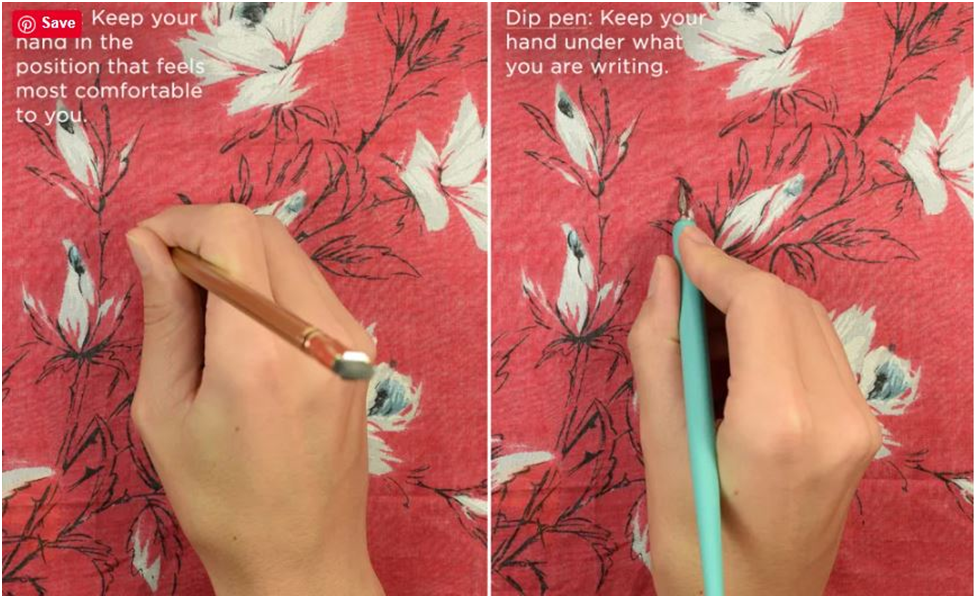
The good news: You don’t need to hold your pencil in a special way to draw calligraphy.
One of the advantages of pencil calligraphy is its familiarity. Go ahead and hold that pencil like you have from the day you learned to write. You don’t need to make any grip adjustments!
How to achieve stroke variations.
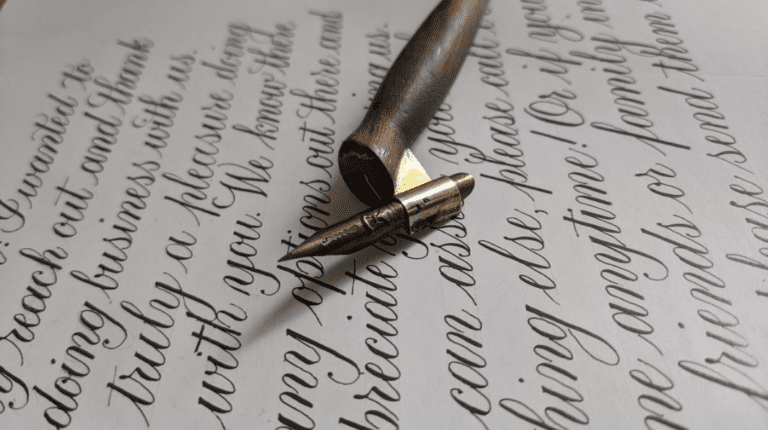
The beauty of dip pen calligraphy is in the stroke variation it can offer. On the downstroke, you get a nice, thick stroke. Upstrokes and horizontal strokes are elegant and thin, creating a pleasing contrast in the finished piece.

This Janet style pencil calligraphy envelope has quite a wonderful stroke contrast.
Believe it or not, you can even achieve stroke contrast with a pencil! If you’ve used a dip pan before, the concept will sound familiar. To create thicker down strokes, apply pressure to the tip of the pencil as you draw it down. For thinner upstrokes, apply minimal pressure.

Pencil calligraphy is best created with a fairly sharp tip. If the tip is too sharp, it will likely droop a bit on the downstroke. It is best to break the tip after each sharpening on a scrap piece of paper.
Use the light box for guidelines.
If you’ve ever done dip pen calligraphy before, you know that it’s logical to use a pencil to create calligraphy guidelines. Guidelines make it easy to write consistent, visually pleasing letters. Then, after the ink is dry, you can erase the pencil guidelines. The obvious downside to doing calligraphy with pencil, then, is the fact that erasable pencil guidelines aren’t an option. If you try to erase your guidelines, your pencil calligraphy will go with them!
If I want to create structured pencil calligraphy, I always use a lightbox. If you don’t have a lightbox, I suggest abandoning convention and going with a relaxed, no-guidelines calligraphy style like Caitlin’s.
Waterproof your paper to prevent fumes.
You probably already know that pencil lines are blurry. With that in mind, if your calligraphy can go through several hands (and smudge-inducing fingers), you might want to consider waterproofing it. In general, waterproof paper is also smoke-proof paper! You can learn how to protect your calligraphy in the Waterproof Paper Post.

I speak from personal experience when I say that if you use micro glazes to cure, your pencil marks will become a bit dull. Instead, I recommend using a finishing spray like Krylon.
Practice pencil calligraphy with free worksheets.
If you want to try your hand at pencil calligraphy, try downloading a free pencil calligraphy worksheet. You can print on whatever paper is currently in your printer.
Before filling out the worksheet, make sure you have a piece of “padding paper” underneath. Placing another piece of paper under the paper you are writing on will make writing easier and easier.
The free worksheet includes the Janet style calligraphy alphabet. This is a very basic worksheet, so it doesn’t go into exactly how to make the letters. If you own the Janet Style worksheet set, you can refer to the Letter Formations section (pages 15-16) to learn the formations. The formation of each letter will be exactly the same as with a dip pen.
Again, you can download and print the free pencil calligraphy worksheet by clicking here. I hope filling it out will be a fun creative challenge for you. Happy practice!
The word calligraphy means “beautiful handwriting”. But it’s not just writing for artists, every alphabet, every word or every line that a calligrapher writes is just like a unique piece of art for another artist. You are never bound by boundaries in calligraphy; in fact, you can add your own touch to this craft. This is the basic beauty of this technique that beginners can expand its variations, and even create new styles.
Different tools are available for many types of calligraphy. But for beginners who are in the early stages of learning this technique, “a pencil and paper” is enough. The biggest advantage of pencil calligraphy over dip pen calligraphy is that it doesn’t involve messy ink and doesn’t require any special pens or paper. This can be done in the simplest and easiest ways.
What tools will you need for calligraphy?
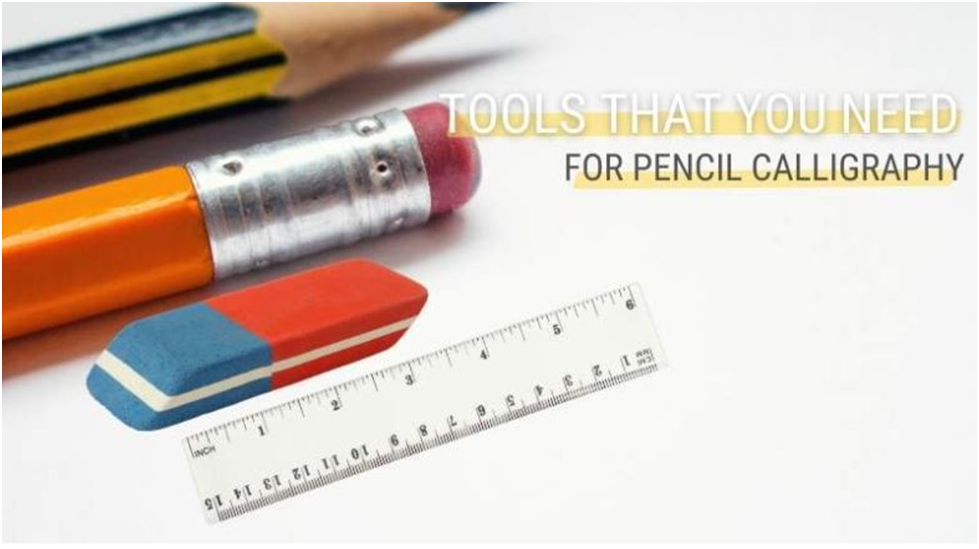
If you want to become a calligrapher, you need to have some knowledge of the tools you are going to work with. Here’s a list of all the regular calligraphy tools you’ll need when doing basic pencil calligraphy.
Pencil
The pencil is by far the most underrated and important calligraphy tool that can do most of the work alone, especially in the case of pencil calligraphy. You can make calligraphy with different types of pencils but HB, 2B, 4B, 6B are the most effective. Because apart from having a soft cover, they also make perfect thick strokes.
You can also use colored pencils to add creativity and appeal to your calligraphy designs.
Other pencil tools are also available i.e. dip pen, dip pen calligraphy and mechanical pencil, for lettering but we don’t need them at the beginner level in pencil calligraphy.
Paper
Beginners can use any cheap and easily available paper for practice. Remember that this paper is for practice and should not cost you anything. Once you achieve your goal, you can move on to other better options.
But don’t spend your money on a piece of paper in the beginning. It will get you nowhere.
I will repeat, invest in the practice, not the tool.
Ruler
A ruler helps keep letters in a line, nice and consistent. But this can also be achieved by using calligraphy practice worksheets that are readily available on the internet in PDF form, which you can download and print on your printer.
Erasers
It’s easy to keep an eraser on your work table. In the beginning, one may make mistakes in pencil calligraphy. And when they do, an eraser will be helpful.
Calligraphy with Pencil: A Step-by-Step Guide
Gather your confidence and with the motto “You can and you will” let’s begin.
Set your workspace.
Keep in mind that calligraphy is a great stress reliever. So a good sitcom place with everything you need properly is a big thumbs up. This will keep you motivated and you will continue to practice without interruption. This workspace can consist of a desk, a comfortable chair, your tools and some of your favorite work accessories.
It can also have a plant so you can breathe fresh oxygen that will keep your mind fresh.
Learn these “Fundamentals”.
The most important and first step when doing pencil calligraphy for beginners is to remember one rule which is:
- Keep the upward strokes light or thin
- Keep the stroke heavy or thick as you go down
If you want to learn calligraphy quickly, you first need to master the basic strokes—thin upstrokes and heavy down strokes
After practicing these strokes you will learn how to connect two letters which is really a piece of cake. All you have to do is connect the end of one stroke to the beginning of another. The same method will be followed in connecting two alphabets.
Be sure to place padding paper underneath your worksheet to get a smooth result. If you don’t have padding paper, you can use your textbook or a flat surface.
Just keep ‘practicing’
After having all the required tools and reading the basics, it is up to you how hard you will put in to learn this skill. The only effort you can make here is to practice your basic strokes.
Remember that now is not the time to run after tools. It is proven that “no tool, no matter how expensive, is capable of making you master a skill unless you devote your time and effort to that skill.”
If you have guidelines, you will have confidence and plenty of motivation until you reach the point of perfection. The point where you will be confident enough to try out your new calligraphy styles and feel proud to show them to others.
Which pencil is good for calligraphy?
And this is an important question because “pencil” is the main ingredient of this recipe, so we need to take a moment to look at the role of the pencil in our calligraphy to better understand the best types of pencils for this role.
Pencils used in calligraphy have to make light strokes and heavy strokes (with more pressure).
Thus a pencil that is capable of doing both of the above would be a perfect match for this technique.
I would say any pencil in the B degree range is perfect for your pencil calligraphy. It can be HB, 2B, 4B or even 8B (but there’s a chance you’ll find it a bit difficult to work with an 8B pencil, so you might as well keep your range to 6B). Because in pencil calligraphy you have to apply pressure to make thick strokes, and this B degree range works perfectly in such situations.
But in case of hand lettering, you need pencils that have H degree range. It can be 2H. 4H, H or a mechanical pencil. Because you don’t need a heavy stroke to write a letter. All you need is a light and easily removable stroke.
One thing to keep in mind is to use non-sharp edges. I repeat do not use a sharpie in any type of calligraphy because the sharpie will break when you apply pressure in the thick strokes below. And it will create a mess that no one wants.
Upstrokes vs. Down strokes
You’ve always noticed with traditional ink dip calligraphy that some lines are thicker than others. It is also possible to achieve this with a pencil. Lines that go downward as you draw will be thicker than lines you draw upwards. The pressure you apply to the pencil during these strokes can increase it. For thicker lines, use more pressure as you go down and less pressure as you move your pencil up to get a sharp but clearly defined line.
Remember that using a sharp pencil when doing calligraphy is a bad idea. You’ll want to use a lighter pencil because the tip of the pencil can break as you stroke down with too much pressure, and the thin lines provided by a sharp pencil won’t give you the flow and continuity you’re looking for. are doing Eccentric calligraphy style. If your pencil needs sharpening, soften the pencil tip by rubbing the tip on a piece of scratch paper before you start writing.
Make sure you pay close attention to the spacing between letters. A powerful down stroke can blur letters together, making what you’re writing look illegible or complicated. Since calligraphy is designed to be beautiful, harmony is a key component that you need to keep at the forefront of your mind as you dive into this art form.
One of the wonderful things about pencil calligraphy is that you can literally draw a thick down stroke by making two lines that you can later color in to make the down stroke look very thick. This creates an even bolder contrast and opportunity for truly fantastic designs as it gives you the opportunity to add inspiration to the lettering in a way that just cannot be achieved with a normal pencil tip.
Faux Calligraphy
Many artists who are teaching students the basics of calligraphy recommend starting with faux calligraphy. Flawless calligraphy involves you writing on a page as you normally would and your writing going to embellish what’s already on the page. Make sure that when you rewrite, that you are applying more pressure on the down stroke than you do on the upstroke. This helps distinguish the lines on the paper, and gives the alphabet you’re trying to get across unmistakable.
Once you’ve mastered the lines you normally write, try to write exactly what you’ve written before, playing with your natural movements during a normal writing session, experimenting with pencil pressure along the way. . Just emphasize your natural down stroke and outline your usual upstroke and see where the pencil takes you.
One of the biggest benefits of calligraphy is that you master the technique of linking your letters together. Make sure you’re connecting the end of one stroke to the beginning of another as you move between characters on the page.
The bottom surface of your calligraphy page
When painting or water coloring, the bottom surface of the page you’re working with isn’t as important as it is when doing pencil calligraphy. If you don’t put a piece of thick paper under the paper you’re writing on, it will look messy because the graphite in the pencil will pick up every bump and groove, especially if you’re writing on a surface. Writing what you are writing about. Table
To pad your main page, use a thick piece of drawing paper or watercolor paper as a barrier between your project and your workstation. This will save you the frustration of experimenting with patterns within your pencil work that you don’t want.
Waterproofing your paper
Pencil lines are prone to smudges, so waterproofing your paper is a great option to avoid this disaster. Once you’re done, use a finishing spray on your art to keep smoke marks from handling. Pencil smears easily, so this is not a step to be overlooked.
You can also use a Vaseline-like substance called micro glaze to seal in your pencil calligraphy. This is great for work done on the outside of envelopes that may be exposed to the elements during shipment. Just use your fingertip to smudge the top of your work to seal it, being careful not to smudge under the writing with too thick an application or too much finger pressure. Felt
Practice worksheets
If you’re feeling overwhelmed about starting the process, try Goggling practice worksheets for calligraphy. These worksheets are essentially cheat sheets, especially for those who aren’t good at cursive but want the flowing nature that comes with this type of writing. Interest is another great place to find these worksheets.
These cheat sheets will have very lightly printed letters, and a horizontal line extending from the first letter, where you can practice the moves you want to achieve over and over again before working on your final project. are trying It’s like creating color palettes before a painting project. This gives you the opportunity to try different pencils and amounts of pressure to determine exactly how you want your final work to look.
If you don’t have a printer to print these cheat sheets, use a ruler to draw lines on a plain piece of paper so you can learn how to line up your letters. When you feel confident enough to dig out the cheat sheets but still not confident enough to do calligraphy without guidance, draw straight lines on another piece of paper that match your top sheet. Can be seen through so your lines are straight. You’ll get the guidance you’re looking for without putting garish lines on your final project.
You can also print out a sheet in a font you enjoy and place it on top of a light box, which is a lighted surface designed for artists to trace work underneath. can see This will allow you to trace the font you’re trying to achieve without having to think too much about line stroke placement. Light boxes can be pricey, but there are inexpensive variations available on the Internet that plug into a USB port and provide the same effect that more expensive models create.
Conclusion
The biggest thing to remember when starting out with pencil calligraphy is that practice will make your line perfect. Practice your basic strokes while applying different pressures to get what you want from your final piece. It’s important to remember that everyone’s calligraphy will be different, as will different handwriting styles, so find the look that best suits your natural handwriting.